A Slack bot that catches vague replies
Designing trust and decision making in cross-cultural product teams
I ran Syncraft live in one real Slack workspace. The rule-based detector fires on hedges, bare-yes, and deadlines with no date, and flags a soft reply the moment it is sent.
01Why this problem matters
The symptoms
Nobody says what a reply is supposed to mean, so everyone guesses. The meetings pile up, and so does the doubt. Many conflicts are not caused by what people say, but by when they expect a response.
The shift
Distributed, cross-cultural teams are no longer an exception, they are becoming the default operating model for product teams. Founders hire across time zones for speed and cost, and teams collaborate without ever meeting in person.
The tool gap
Today’s tools optimize for workflow, not for collaboration psychology.



- ✓Communication
- ✓Documentation
- ✓Coordination
- ✗Trust building
- ✗Emotional context
- ✗How decisions actually happen
They help teams work, but not necessarily work together.
What exactly breaks in cross-cultural collaboration?
02Research and methods
Stakeholder interviews
Four in-depth interviews, with two startup founders and two remote engineers across the US, India, and Taiwan.
Problem research
A literature review grounded in frameworks from Erin Meyer, Hofstede, and remote collaboration studies.
Research prototype
I built a rough prototype to watch what people did with it, not to ask them what they thought.
03Problem concreting
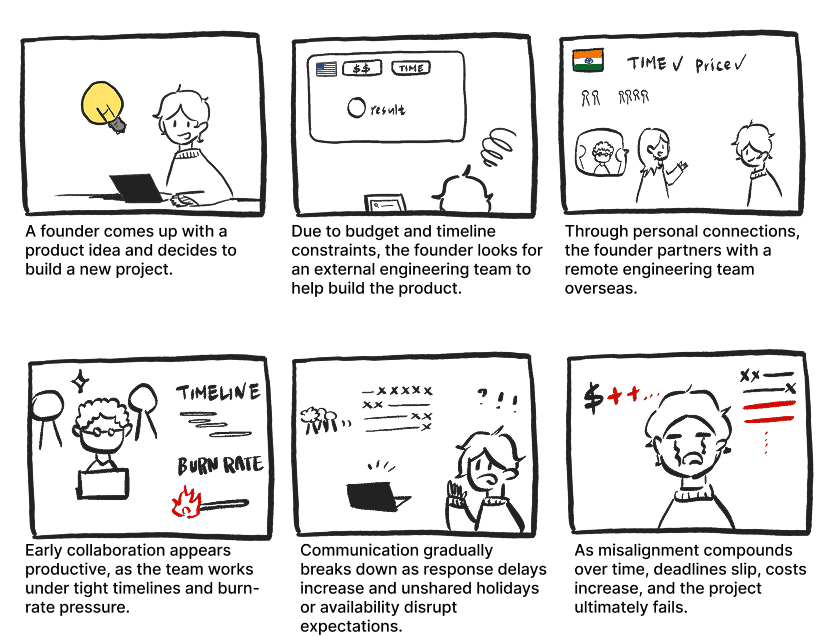
Across different teams and contexts, the same breakdowns kept appearing. I mapped one recurring scenario as a storyboard to make the moment of mismatch concrete.

04Key insights
Looking across these scenarios, several deeper patterns emerged.
Timing is interpreted as commitment and care.
In cross-cultural remote teams, response time is not just logistics, it is interpreted as a signal of responsibility, priority, and trust.
The same words do not encode the same level of commitment.
Phrases like “OK” or “I’ll look into it” carry different meanings across cultures and power relationships.
Urgency is currently invisible and guessed, not designed.
In Slack, a casual question and a blocking request look exactly the same. Teams rely on tone, guessing, and social pressure to infer urgency.
How might we make response expectations and collaboration rhythms visible and negotiable in cross-cultural remote teams?
The solution
So I built the answer, not a recommendation. Syncraft is a Slack-native clarity layer for cross-cultural teams: it catches the moment a reply goes soft, then nudges the sender, privately, toward what they mean.
View the code on GitHub ↗The logic
Listen, detect, nudge, commit. Syncraft watches public channels and detects when a reply goes vague, a soft yes, a hedged maybe, a deadline with no date. When it reads clearly, Syncraft stays silent. When it does not, it nudges the sender, privately, with firmer ways to say it, and they commit to one. Or they don’t. The last word is always theirs.
A soft reply, made firm. Tap the message, then pick a clearer line.
Type a reply, or tap a sample. Same rule-based checks as the real thing, no LLM: a formality score plus hedge, bare-yes, and deadline-without-a-date detection.
It reads the clock, too
Half the trouble is timing. Syncraft knows the hours each teammate keeps, so a 1 AM ping comes with a quiet note about who is awake instead of a guilt trip.
I’m confused about the API. @You I know you’re awake
 SyncraftAPP
She's likely asleep in Bangalore. Expected reply 6 to 10 hours. Better around 10 AM her time.
It reads the clock, too. Toggle her local time.
The system behind it
Under the nudge is a rule-based system, not a model. Syncraft keeps only the shape of how people write, message length, greeting habits, the hours they answer, never the words themselves. It aggregates that into a quiet read of each person’s style, does the time-zone math to know who is awake, and composes suggestions from templates. No LLM. No stored transcript. Nothing it could not explain to the team trusting it. A single SQLite file, public channels only, opt-in, and you can erase your data whenever.
It ran
Not a mockup. Syncraft sat in a real workspace for the length of the thesis, nudging real replies between real people.
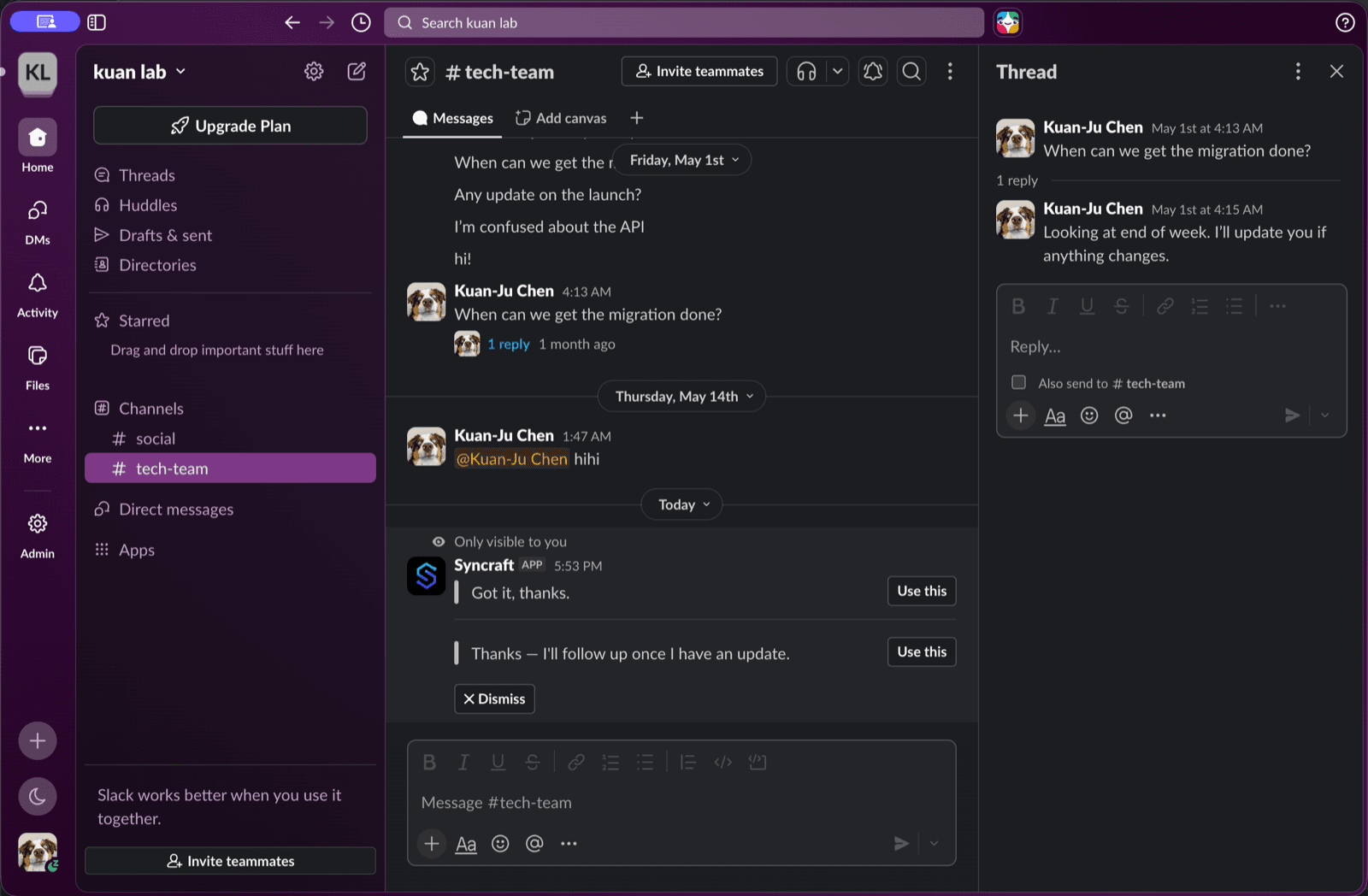
One answer, the size of a single message.
05Reflection
The smallest intervention wins
I set out to fix how cross-cultural teams communicate and ended up building something that speaks for half a second, once, at the moment a reply goes soft. The thesis kept pulling toward systems: dashboards, norms, settings. The prototype kept pulling the other way. The real leverage was not a new way to run a team. It was a nudge the size of a single message, at the one point where meaning slips.
Restraint was the hard part
A tool that reads your team’s messages has to earn the right to exist. I assumed the hard work would be the suggestions. It was the silence. Deciding when Syncraft should say nothing, keep nothing, and step back took more judgment than any feature did. The version I trust is the one that does the least.
I could build the thing I argued for
For once the prototype was not a mockup. With Claude Code and Codex I wrote the rules down and watched them run in a real Slack workspace. Be clear about the scope: one workspace, a thesis prototype, not a product a thousand teams lean on. But the distance between arguing for an idea and holding a working version of it got short enough to cross inside a thesis. That quietly changes what a designer is for.